
The Ratio of Two Biscuits

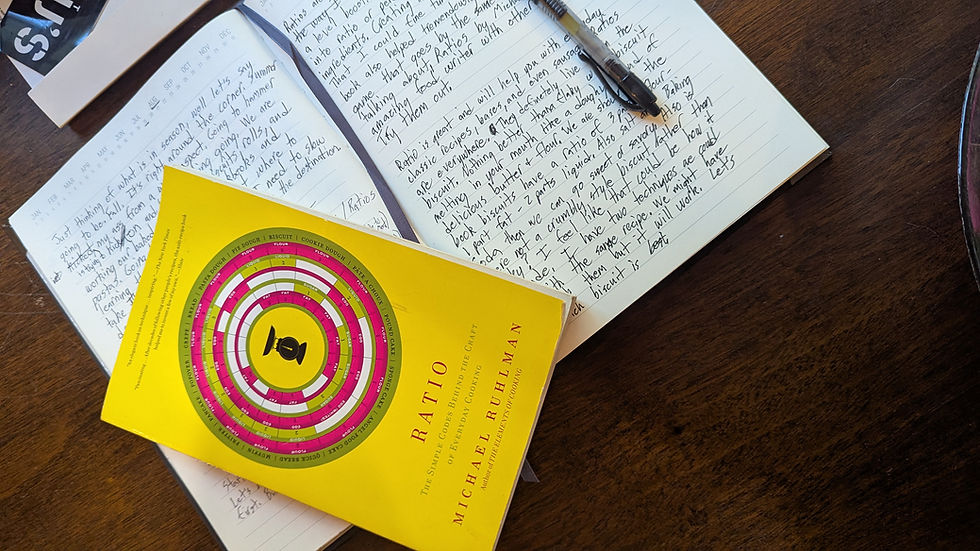
Ratios are one thing that took my cooking theory and the way I think about food to another level. Thinking of a recipe broken down into ratios or percentages, rather than individual ingredients, gave me a loose recipe that I could fine-tune over the years.
One book that did this tremendously was Ratio (go figure) by Michael Ruhlman, an amazing food writer with other great books as well. Try them out.
Ratio is great and will help you with everyday classic recipes, bases, and even sausage. Ratios are everywhere. Learning these basic recipes will level up your cooking game just a little bit more as well.
They definitely live within the biscuit. Nothing is better than a flaky, warm biscuit melting in your mouth like a dissolving cloud layer by layer through delicious butter and flour.
In the book, we are shown that biscuits have a ratio of 3 parts flour : 1 part fat : 2 parts liquid, along with salt and baking soda. From there, we can go sweet or savory. Today we are learning the basic biscuit to build off of.
But what if there were more than one way to make a flaky biscuit? I want to approach slow and quick. I have two techniques I want to try with the same recipe. We might have to tweak them, but it will work.
Let's see which biscuit is best.
The Two Techniques
Back to biscuits, with our two techniques to approach them. One requires a mixer, while the other just requires your hands. This way, you can do both—or either. The tortoise and the hare. Will the tortoise technique beat out the hare?
They will both require freezing temperatures, or at least a good chill. Each technique delivers flaky results with slightly different textures.
You decide your favorite to eat or make.
Sticking to our 3-1-2 ratio of flour, fat, and liquid, we will make six biscuits per recipe. Plain Jane will be the name of the game, so our flour flavor will be important.
I personally use Montana flour. I love the nutty flavor it gives my breads. It does not hurt that they are right next door, either. Find a flour you enjoy and go from there.
Basic Biscuit
Ratio
Flour 300 grams
Butter 100 grams
Milk 200 grams
Baking Powder 2 tsp
Salt 2 tsp
Technique One — Mixer
Dice almost-brunoise butter or freeze it with flour in a mixing bowl with paddle.
Beat until flaky butter pieces form, then replace the paddle with a dough hook and add the milk until the dough pulls from the sides.
Form the dough into a 6×6-inch square, wrap in plastic, and chill for 1½ hours.
Remove and roll out. Fold the dough into itself 3 times and flatten. Chill for 1 hour.
Repeat the process 2 more times.
Roll out into a 4×6-inch rectangle, ¾-inch thick, and cut into six even biscuits.
Bake at 400°F for 20–30 minutes on a baking sheet with parchment paper until golden brown.
Let cool on a wire rack and enjoy.
Short Form — By Hand
Mix dry ingredients.
Cut in the butter using your fingertips, smashing the flour and butter together until homogenous. I mean small, pea-sized butter flakes should exist.
Slowly add milk while folding and mashing until an almost-flaky dough is formed. If too dry, drizzle in a little more milk until you reach the right consistency.
Roll out to a ¾-inch-thick rectangle. Fold into itself 3 times and roll back out to ¾-inch thick.
Cut into 3-inch circles.
Bake at 400°F for 20–30 minutes.
Two techniques. Same ratio.
Let's see which biscuit is best.
To be continued…
The Larder - Crafted by the Hunt

Comments